Storyboard
Storyboards are a way of planning shots
This is your pre-production blueprint. If you are doing animation, storyboards are mandatory—you need to plan every camera angle and cut before you start animating.
There is no standard way to create a storyboard, but there are key elements to consider:
1. Visuals:
The drawings themselves. They can be simple stick figures or detailed sketches, depending on your needs.
2. Camera Directions:
Notes about how the camera should move, zoom, or cut. This is crucial for animators and editors to understand the intended flow.
3. Timing:
Indications of how long each shot should last. This helps with pacing and rhythm, especially in animation where timing is everything.
4. Special Effects Notes:
If there are any effects (like smoke, fire, or lighting), you can note how these should be achieved (e.g., "Add digital smoke here").
5. Layering Instructions:
For complex scenes, you might indicate which elements are on separate layers (e.g., "Characters on one layer, background on another"). This is important for compositing and animation.
6. Dialogue or Sound Notes:
If your storyboard includes dialogue or sound effects, you can note these as well, though they are often handled in a separate "script" document.
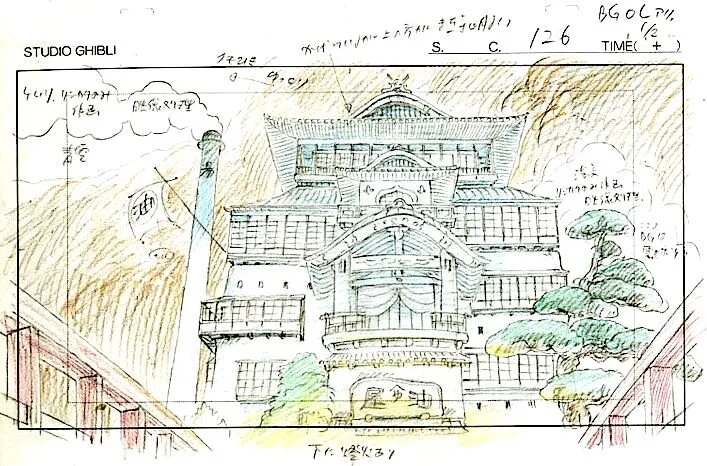
Examples of hand-drawn storyboards from Studio Ghibli's Spirited Away
Storyboard Notes
1. The Bathhouse Exterior (Establishing Scale & Effects)
The Visual: A massive vertical shot of the bathhouse, including the bridge and the smokestack.
The Japanese Text & Meaning:
Top Note (O-Frame): You see a circle with text near the top. This marks the "O-Frame" (Open Frame), indicating the start or end position of the camera.
"Kemu" (ケム): Written near the chimney. This is short for Kemuri (Smoke). He doesn't draw detailed smoke; he just writes "Smoke goes here" to save time.
"Digital shori" (デジタル処理): There is a note about "digital processing" for the smoke/steam. This tells the compositing team: "Don't animate this by hand, do it with CGI effects."
Lesson for Students: You don't have to draw everything. If something is complex (like smoke or fire), just draw a shape and write "Fire" or "Digital Smoke."
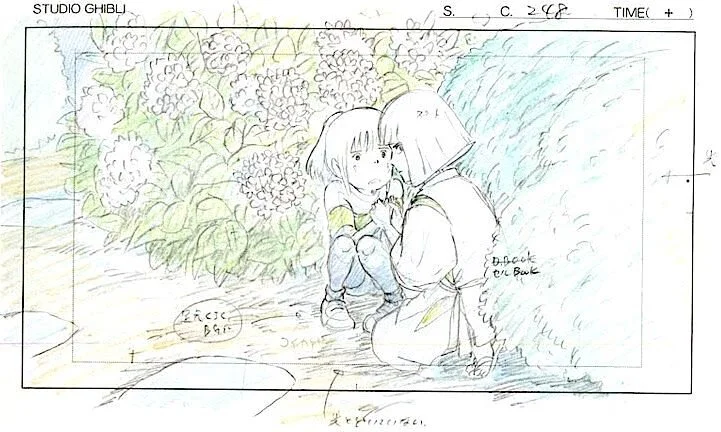
2. Haku Comforting Chihiro (Framing & Mood)
The Content: An intimate, low-angle shot of Haku comforting a crying Chihiro, who is crouched and hidden among large hydrangea bushes.
The Technique (Foreground Framing): The large bush on the right has notes labeling it as a "Book" (specifically "Cell Book"). By placing this layer right in front of the camera, it creates a "frame within a frame." This physical barrier makes the audience feel like they are hiding in the bushes with the characters, reinforcing the emotional intimacy and secrecy of the moment.
The Text Notes:
Directing Shadows: There is a faint note pointing toward the ground that translates to "light does not reach here" (光とどいていない). This is a crucial instruction for the background painters and colorists to keep the characters cloaked in heavy shadow, setting a somber and hidden mood.
Action Cues: A small "Sū" (スッ) is written near Haku, which is an onomatopoeia for a quick, quiet sliding or settling motion, telling the animator exactly how he should enter the frame.
3. The Train Ride (Continuous Backgrounds)
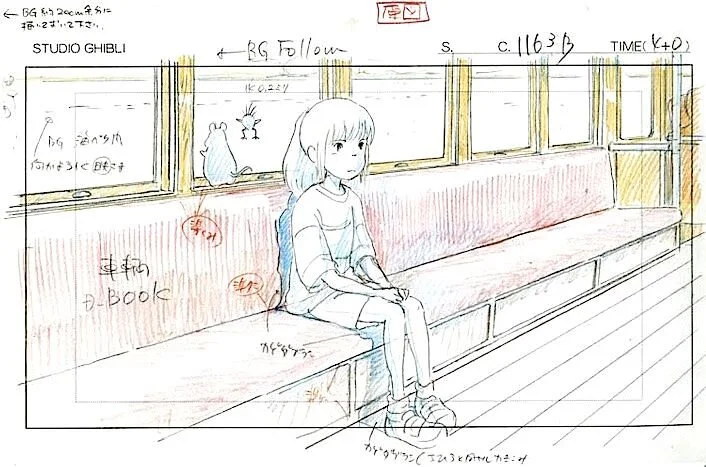
The Content: Chihiro sitting quietly on the padded train seat, looking out the window, accompanied by Boh (as a mouse) and the Yubird.
The Technique (Motion): The top text explicitly reads "<- BG Follow". The camera is locked onto Chihiro inside the carriage, while the background outside the window slides continuously to the left to simulate the train's motion.
The Text Notes: In the top left, a critical production note reads "BG 約 200m 余分に描いておいて下さい" which means "Please draw about 200m extra of the Background". Because the shot will hold for a long time, Miyazaki is calculating exactly how much continuous landscape the background painters need to create so the scenery doesn't run out during the shot. The seat itself is labeled "D-Book", showing the interior train car is a static foreground layer.
4. Chihiro and No-Face (Lighting & Layers)
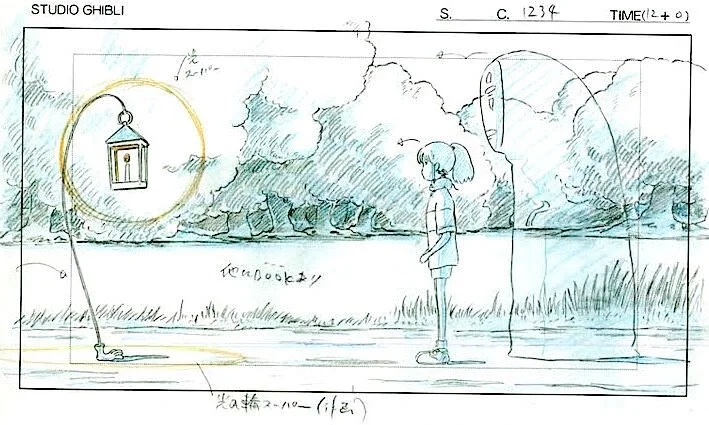
This scene features Chihiro and No-Face (Kaonashi) standing on a road, accompanied by the hopping one-legged lantern. This is from the sequence where they travel to Zeniba’s swamp bottom house.
The Technique (Lighting & Layers):
The Yellow Circle: There is a distinct yellow circle drawn around the lantern's flame. The text notes near this point to a "Super" (Superimposition) effect for the light ring. It tells the compositing team: "Add a glowing halo effect here."
"Book": You can see the word "Book" written in the middle. As mentioned in previous examples, this refers to a separate background layer. It likely indicates that the grassy bank or the road is a separate element from the characters, allowing for independent movement or focus.
Timing: The top right says "TIME (2+0)", meaning this specific shot lasts exactly 2 seconds. This precise timing helps the editor build the rhythm of the quiet, waiting moment.
Summary of the Lesson:
In both examples, the storyboard serves as a technical blueprint. It tells the special effects team where to add digital smoke, the lighting team where to add a glow, and the camera team how to move up the building. The art is beautiful, but the notes are the instructions that make the film possible.
5. The Cheering Crowd (Layering for Efficiency)
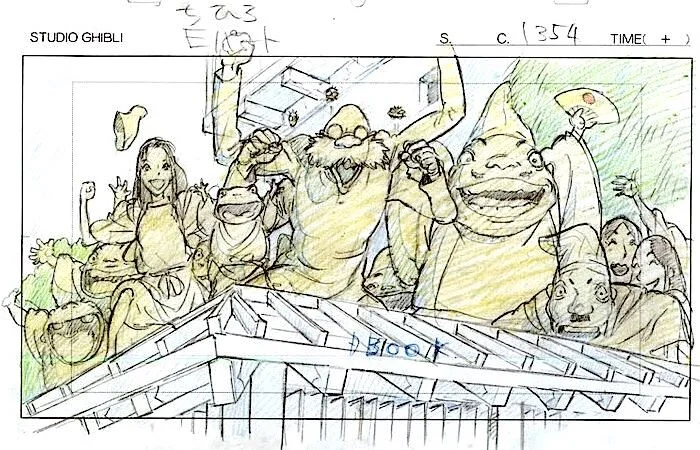
The Content: A crowd of bathhouse spirits (including frogs and a radish spirit) cheering enthusiastically over a balcony or roof structure.
The Technique (Masking): The blue text "D. BOOK" is written directly across the wooden roof structure in the foreground.
The Text Notes: By explicitly labeling the roof as a "Book" (separate background layer), Miyazaki is telling the animators that they do not need to worry about drawing the roof lines over and over. They can animate the chaotic crowd on one layer, and simply drop the static "D. BOOK" roof layer over top of them to hide their legs.